I finally got started to glue the coaming parts in. I just bonded the edges of the fronts, keeping the shape with wood battens. As I only pre laminated the inside they are quite floppy. When cured, I taped the inside joins. This is starboard coaming with finished inside taping.
I managed to cut back too much of the port hull and had to glue back a strip. Kept in place with crossing tooth-picks while curing. Also showing drain hole and the aft "anti fall down to the lower compartment thing".
Detail of inside storage compartment, port side looking aft. Edge still to be dug out and filled, or maybe laminated over.
This picture is showing port side glueing flanges curing. They were added a.m Menno, ie using building foam as a mould. I wrapped the foam in vacuum plastic, adding the need for weighing down the flanges during cure and hopefully making the foam removable.
I might, but plan not to, add small winches on the coamings for screacher (klyver) and spinnaker (jager). I added a piece of high density foam and laminated a carbon reinforcement to the coaming tops just in case. Curing under vacuum. Also a piece of four layers heavy carbon weave to transfer fabric weight in to laminate thickness using vacuum lamination, preparations for bow pole (klyverbom) and traveller (løygang) manufacture.
After a really long period of indecisiveness I finally decided to add a Tohatsu 6 Sail Pro to a stern mounted bracket. This one. Will enable the engine to be retracted up and forward when not in use. I will have the possibility to add an engine well at a later stage, there are long winters and short summers here. Speaking of summer, this picture also showing the new heater which is doing a great job keeping the Norwegian summer (7,5 ºC tonight) out of the workshop and leaving me my spare time to finish a boat.
Saturday, June 05, 2010
Thursday, June 03, 2010
May in retrospect
May turned out, as it tends to do every year, as a very busy month where one ends up feeling that very little have been accomplished in any field. That's probably not quite true, but to a certain degree. Not much happened to the F22 anyway. The minitonner, on the other hand, was launched, and has sailed two races so far, including yesterdays Wednesday night beer can race. We started out in very light airs and kept the 33 ft+ competitors quite well until the wind headed and picked up to ~16-18 kt and the cross cut dacron main took on a huge S-shape. Then the wind died totally on our way back, just when the big boats reached the finish line. We corrected in in the middle of the pack and had a good time. Have to check out the old kevlar main, it might be some hours left in that.
I vacuum laminated five layers of plywood to be the central trailer bunk board, while strapping it to the hull to make the right shape:
The F22 was then turned back with the sunny side up, and I have started with the cockpit coamings. I make small compartments accessible from the inside in the front part, and a big cut out for the rest of the storage space. In the aft end of this I did as other builders have described, I put up a small "wall" to stop things to fall down in the under seat compartment, but keeping the space open for airflow. This will make for a ventilated under seat compartment even if I choose to put doors on the openings. I guess I will reinforce for a small winch on the coamings, should the two cabin top winches turn out not to be sufficient, but the main plan is to use two winches only.
CNC-ed foam for the rudder is still not finished.
I vacuum laminated five layers of plywood to be the central trailer bunk board, while strapping it to the hull to make the right shape:
The F22 was then turned back with the sunny side up, and I have started with the cockpit coamings. I make small compartments accessible from the inside in the front part, and a big cut out for the rest of the storage space. In the aft end of this I did as other builders have described, I put up a small "wall" to stop things to fall down in the under seat compartment, but keeping the space open for airflow. This will make for a ventilated under seat compartment even if I choose to put doors on the openings. I guess I will reinforce for a small winch on the coamings, should the two cabin top winches turn out not to be sufficient, but the main plan is to use two winches only.
CNC-ed foam for the rudder is still not finished.
Wednesday, May 19, 2010
Mini tonner preparations
Not much time available for boat building lately, and a good portion of what have been available have been put into getting the mini tonner ready for launching. We were very close on May 16th but unfortunately, in the process of getting the boat out trough a too small barn door using a big tractor, a heavy piece of farming equipment turned out to be more rugged than the carbon/foam rudder blade. The rudder has now been rebuilt, with a mono hull kind of approach (quick and easy, won't see noticeable speeds anyway).
And primed:
As well as all the remaining up side down taping have been finished, with the hull in an up side down position. This is one of the lower folding strut bracket bolting areas with external laminations finished on the inverted hull.
And primed:
As well as all the remaining up side down taping have been finished, with the hull in an up side down position. This is one of the lower folding strut bracket bolting areas with external laminations finished on the inverted hull.
Wednesday, May 12, 2010
Even more catching up things and other invisible progress
I'm at a stage now, and probably will be for the remainder of the building period, where a lot of time spent does not really show in a photography. A long time ago I obviously found that it was wise to wait with the internal lamination of the rudder centre web starboard side until the hull was in a better position. I did find it in that position today. Sanding down old putty, cleaning, filleting and laminating in a close to inaccessible space takes time, but here it is:
Then almost all of the anchor well taping is done. I still have to do the underside deck to forward well wall taping, which will be done as soon as the hull is up side down again.
All glueing flanges for the custom carbon fibre holding tank top are done.
The winter came by once more, just as my wife's electrical car had broken down and had to be transported to a distant workshop where such cars can be fixed.
It turned out the main solenoid was burned and I will go and get it tomorrow.
Port side structural aft coaming have been fitted and laminated inside
And holding tank top and coaming panels are under construction.
Then almost all of the anchor well taping is done. I still have to do the underside deck to forward well wall taping, which will be done as soon as the hull is up side down again.
All glueing flanges for the custom carbon fibre holding tank top are done.
The winter came by once more, just as my wife's electrical car had broken down and had to be transported to a distant workshop where such cars can be fixed.
It turned out the main solenoid was burned and I will go and get it tomorrow.
Port side structural aft coaming have been fitted and laminated inside
And holding tank top and coaming panels are under construction.
New heater. Port cockpit seat taping
I finally got so tired of the Foma Powerheater 40S that I ordered a new heater. Italian, industrial type. The main difference is that the new runs an 11 bar diesel pump instead of the passive suction type construction of the Foma. This is said to be a much more reliable type of heater, and obviously it burns cleaner and more effective with the high injection pressure. It's also 20% higher power (52 kW), twice the airflow, has an external 1000 l (~260 gallons) diesel tank so carrying Jerry cans are history. It makes less and much more pleasant noise. The result is that my workshop now has an even temperature and much better air, and I can spend more time building the boat. I almost always regrets it when I try to save a few bucks....
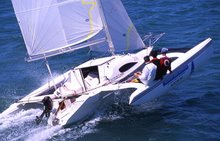
Here it is:
I had a visitor (Eirik, familiar with both Snipe and keel boat racing, and full of interesting knowledge) and had to turn the boat over again to discuss a few constructional details. The result might be a slightly different self tacking system than what I planned. When he left I just turned the hull up on port gunwale and carried on with the taping of the port cockpit seat.
The remaining outside joins:
And underside taping:
Here it is:
I had a visitor (Eirik, familiar with both Snipe and keel boat racing, and full of interesting knowledge) and had to turn the boat over again to discuss a few constructional details. The result might be a slightly different self tacking system than what I planned. When he left I just turned the hull up on port gunwale and carried on with the taping of the port cockpit seat.
The remaining outside joins:
And underside taping:
Tuesday, May 04, 2010
Summer?? Mousefur and sanding
May. After the coldest winter in more than 50 years I had been looking forward to this as May should bring the green colour out accompanied by the wonderful smells of life emerging from the remnants of winter. We should be able to wear a few layers of clothes less than the previous months, and maybe even no shoes! Seems not. This is what I saw out the window yesterday, trying to get a glimpse of the fjord.
Seems like it could be a while before we harvest the fruit and berries in the garden as well. What happened to global warming?
I am a big fan of savings in fairing compound, both labour, money and weight wise. Which means I will not spend time or money fairing the interior, except perhaps a few small details. A nice finish and welcoming atmosphere is however desirable. Farrier/Corsair have solved this using Frontrunner(R) fabric, which is also recommended by Ian Farrier as a durable and light weight fabric, so I have tried to source that particular fabric for the purpose. It is, as far as I have been able to establish, not available in Europe, but Litestream in Las Vegas has this fabric in stock, and was selling for a reasonable price, however the shipping to Norway was way more than the fabric itself, and then Norwegian taxes on top of that....
Trough help from the Yahoo! F-boat group I was able to find alternative fabrics in Europe and yesterday I received a sample of VV Softex Grey A70 n from Meubelstoffenvoordeel.nl. It has a comfortable colour and texture, is light weight, are made for a moist environment and passed my 8 month old daughter's chewing-test (durable).
The sample:
It also convincingly passed the enhanced velcro-test:
So then, Dutch Softex it will be.
I was planning to laminate the external beam mount lower folding strut bracket bolting areas yesterday. I didn't get to it, as the preparation work with rounding corners and filling gaps turned out to be a major time consumer. But I'm getting there. Forward lower folding strut bracket bolting area with hull turned up side down.
I also used a paint roller handle to make a special-tool for diggging out foam from tight locations, in this case the cockpit drain holes, wish I did this a long time ago, it made foam digging (a formerly detested activity) almost enjoyable.
Seems like it could be a while before we harvest the fruit and berries in the garden as well. What happened to global warming?
I am a big fan of savings in fairing compound, both labour, money and weight wise. Which means I will not spend time or money fairing the interior, except perhaps a few small details. A nice finish and welcoming atmosphere is however desirable. Farrier/Corsair have solved this using Frontrunner(R) fabric, which is also recommended by Ian Farrier as a durable and light weight fabric, so I have tried to source that particular fabric for the purpose. It is, as far as I have been able to establish, not available in Europe, but Litestream in Las Vegas has this fabric in stock, and was selling for a reasonable price, however the shipping to Norway was way more than the fabric itself, and then Norwegian taxes on top of that....
Trough help from the Yahoo! F-boat group I was able to find alternative fabrics in Europe and yesterday I received a sample of VV Softex Grey A70 n from Meubelstoffenvoordeel.nl. It has a comfortable colour and texture, is light weight, are made for a moist environment and passed my 8 month old daughter's chewing-test (durable).
The sample:
It also convincingly passed the enhanced velcro-test:
So then, Dutch Softex it will be.
I was planning to laminate the external beam mount lower folding strut bracket bolting areas yesterday. I didn't get to it, as the preparation work with rounding corners and filling gaps turned out to be a major time consumer. But I'm getting there. Forward lower folding strut bracket bolting area with hull turned up side down.
I also used a paint roller handle to make a special-tool for diggging out foam from tight locations, in this case the cockpit drain holes, wish I did this a long time ago, it made foam digging (a formerly detested activity) almost enjoyable.
Monday, May 03, 2010
Skiing Vallee Blanche and some taping
I had a wonderful day, skiing with my sister the Vallee Blanche. When I grew up in Lillehammer I had a poster of Aiguille de Midi on the wall, but this is the first time I have ever been here, it took me 30 years. I wish for a next time within the next 30, possibly with a ski ascension of the Mont Blanc summit....
Then back to taping cockpit panels and anchor well. As well as making glueing flanges for the buffer tank. I started by laying the hull over on the starboard gunwale.
This made for an easy access to a lot of taping. I made a flange for the buffer tank top/forward raised floor on the daggerboard case support web.
Then substantial parts of the anchor well was taped to the hull, both inside and outside.
And I was able to tape, quite comfortably with a good result, the cockpit seat underside. This is a peep trough the small aft cutout.
I even got the structural aft coaming part adapted and the inside taping done on starboard side.
Then, in preparations for the forward compartment cockpit seat underside taping, including inside the safety compartment, I turned the hull another 90 deg over. This will also give excellent working conditions for the rest of the interior anchor well taping, cockpit seat top to seat front taping, back filling the cockpit drain holes, external laminations of the lower beam mount parts as well as laminating the trailer bunk board from several layers of plywood. This is how I left the workshop with an increasingly less cooperative heater.
I might need to replace the Foma heater as it is notoriously unreliable and snow is still falling every second day so boat work without a heater is out of the question. I should probably have been born in a more friendly climate, had anyone known I would develope such strong attraction to abnormal sailing vessels... (Did that make any sense in English by the way? Remember, I'm Norwegian)
Then back to taping cockpit panels and anchor well. As well as making glueing flanges for the buffer tank. I started by laying the hull over on the starboard gunwale.
This made for an easy access to a lot of taping. I made a flange for the buffer tank top/forward raised floor on the daggerboard case support web.
Then substantial parts of the anchor well was taped to the hull, both inside and outside.
And I was able to tape, quite comfortably with a good result, the cockpit seat underside. This is a peep trough the small aft cutout.
I even got the structural aft coaming part adapted and the inside taping done on starboard side.
Then, in preparations for the forward compartment cockpit seat underside taping, including inside the safety compartment, I turned the hull another 90 deg over. This will also give excellent working conditions for the rest of the interior anchor well taping, cockpit seat top to seat front taping, back filling the cockpit drain holes, external laminations of the lower beam mount parts as well as laminating the trailer bunk board from several layers of plywood. This is how I left the workshop with an increasingly less cooperative heater.
I might need to replace the Foma heater as it is notoriously unreliable and snow is still falling every second day so boat work without a heater is out of the question. I should probably have been born in a more friendly climate, had anyone known I would develope such strong attraction to abnormal sailing vessels... (Did that make any sense in English by the way? Remember, I'm Norwegian)
Subscribe to:
Posts (Atom)